Showing posts with label emprace. Show all posts

Sunday, January 5, 2014

ACCORDION


spilling crimson says....
 Accordion appeared in popular music from the 1900s-1960s. This half century is often called the "Golden Age of the Accordion". Three players, Pietro Frosini and the two brothers Count Guido Deiro andPietro Deiro, were major influences at this time.
Most Vaudeville theaters closed during the Great Depression, but accordionists during 1930s-1950s taught and performed for radio. During the 1950s through the 1980s the accordion received significant exposure on television with performances by Myron Floren on The Lawrence Welk Show. In the late 1950s and early 1960s, the accordion declined in popularity.

A folk accordionist 2009
In popular music, it is now generally considered exotic or old-fashioned to include the accordion, especially in music for advertisements. Some popular acts do use the instrument in their distinctive sounds. A notable example is Grammy Award winningparodist "Weird Al" Yankovic, who plays the accordion on many of his musical tracks, particularly his polkas. Yankovic was trained in the accordion as a child.
1831, from German Akkordion, from Akkord "musical chord, concord of sounds, be in tune" (cf. Italian accordare "to attune an instrument"); ultimately from same source as English accord (v.), with suffix on analogy of clarion, etc. Invented 1829 by piano-maker Cyrill Demian (1772-1847) of Vienna.

Wednesday, February 13, 2013

Johann Wolfgang von Goethe


spilling crimson says....Dar
i“If you treat an individual as he is, he will remain how he is. But if you treat him as if he were what he ought to be and could be, he will become what he ought to be and could be.” 
“Nine requisites for contented living: 
Health enough to make work a pleasure.
Wealth enough to support your needs.
Strength to battle with difficulties and overcome them.
Grace enough to confess your sins and forsake them.
Patience enough to toil until some good is accomplished.
Charity enough to see some good in your neighbor.
Love enough to move you to be useful and helpful to others.
Faith enough to make real the things of God.
Hope enough to remove all anxious fears concerning the future.”


“I love those who yearn for the impossible.” 
“Things which matter most must never be at the mercy of things which matter least.” 

 ideas are like chessmen moved forward; they may be beaten, but they may start a winning game.

Johann Wolfgang von Goethe


Thursday, March 8, 2012

“If I can stop one heart from breaking…” Emily Dickinson


spilling crimson says....


“If I can stop one heart from breaking…” 
Emily Dickinson 

If I can stop one heart from breaking, 
I shall not live in vain; 
If I can ease one life the aching, 
Or cool one pain, 
Or help one fainting robin 
Unto his nest again, 
I shall not live in vain.” 


Emily Dickinson

Wednesday, February 1, 2012

El Poder de los Sueños,The Power of Dreams


El Poder de los Sueños, Alejandro Lerner & Soledad Pastorutti

There is a light somewhere where ¿¿are the dreams of mankind?? there's a light inside you ¿¿where dreams are gonna come? to return to wake up do not forget to never stop dreaming Never stop dreaming of a light is not shining from within since childhood there is a light somewhere in there where my dreams come true beyond the sun across the sea beyond the time that there is a place where I want to go where I want to be Today's fantasy becomes reality beyond the sea beyond the time that there is a place where I want to go where I want to be today's fantasy becomes reality TODAY fantasy becomes reality Beyond the sun beyond the sea beyond the time it there is a place where I want to go where I want to be today's fantasy becomes reality

Friday, January 27, 2012

DREAM MOODS vs REALITY CHECK

spilling crimson says....When you are dreaming, awake or not all images and desires conjured by the unconscious. All your  pleasures, desires, unchecked impulses, urges and wish fulfillment are expressed in   an internal  language in order to preserve your persona in a civilized society like ours.
Your escape from this  struggle is to dream .....concerned with the conscious, the rational, the moral and the self-aware aspect of the mind. 

Morrissey - let me kiss you


Monday, July 11, 2011

MAULA MERE ~ANWAR (MY GOD)

spilling crimson says....God is most often conceived of as the supernatural creator and overseer of the universe.
Many arguments which attempt to prove or disprove the existence of God have been proposed by philosophers, theologians, and other thinkers for many centuries. In philosophical terminology, such arguments concern schools of thought on the epistemology of the ontology of God.

Stephen Jay Gould proposed an approach dividing the world of philosophy into what he called "non-overlapping magisteria" (NOMA). In this view, questions of the supernatural, such as those relating to the existence and nature of God, are non-empirical and are the proper domain of theology. The methods of science should then be used to answer any empirical question about the natural world, and theology should be used to answer questions about ultimate meaning and moral value. In this view, the perceived lack of any empirical footprint from the magisterium of the supernatural onto natural events makes science the sole player in the natural world.
Another view, advanced by Richard Dawkins, is that the existence of God is an empirical question, on the grounds that "a universe with a god would be a completely different kind of universe from one without, and it would be a scientific difference."
Carl Sagan argued that the doctrine of a Creator of the Universe was difficult to prove or disprove and that the only conceivable scientific discovery that could challenge it would be an infinitely old universe.

Tuesday, July 5, 2011

France Gall - "Ella, Elle L'a" TRIBUTE TO ELLA FITZGERALD


spilling crimson says....Ella Jane Fitzgerald (April 25, 1917 – June 15, 1996), also known as the "First Lady of Song" and "Lady Ella," was an American jazz and song vocalist. With a vocal range spanning three octaves (Db3 to Db6), she was noted for her purity of tone, impeccable diction, phrasing and intonation, and a "horn-like" improvisational ability, particularly in her scat singing.

She is considered to be a notable interpreter of the Great American Songbook. Over a recording career that lasted 59 years, she was the winner of 13 Grammy Awards and was awarded the National Medal of Arts by Ronald Reagan and the Presidential Medal of Freedom by George H. W. Bush.

Monday, July 4, 2011

Yanni - Nostalgia - Royal Albert Hall, London


The term nostalgia describes a yearning for the past, often in idealized form. The word is a learned formation of a Greek compound, consisting of νόστος (nóstos), meaning "returning home", a Homeric word, and ἄλγος(álgos), meaning "pain, ache". It was described as a medical condition, a form of melancholy, in the Early Modern period, and came to be an important topic in Romanticism.

source WIKIPEDIA
In common, less clinical usage, nostalgia sometimes includes a general interest in past eras and their personalities and events, especially the "good old days" of a few generations back recast in an idyllic light, such as the Belle Époque, Merry England, Neo-Victorian aesthetics, the US "Antebellum" Old South, etc. Sometimes it is brought on by a sudden image, or remembrance of something from one's childhood.

Thursday, June 23, 2011

Olivia Newton John - Just the way you are

spilling crimson says....

Tuesday, June 21, 2011

Sunday, June 19, 2011

SUPERTRAMP (Roger Hodgson) - Lovers In The Wind


Time is always on the run, we've only just begun, lovers in the wind

Life is all we have to share, you know we must take care

Lovers in the wind


There was a time, when it was hard to know

reaching out, reaching out for somewhere to go

There was a light born on the darkest day

but no one wants to know, and no one wants to try


Love is all I have to give, it's all I need to live, lovers in the wind


There was a time, when it was hard to know

reaching out, reaching out for somewhere to go

There was a light born on the darkest day

but no one wants to know, and no one wants to cry


Time is always on the run, we've only just begun, lovers in the win
d


Friday, June 10, 2011

Morality and Love


Waterboys - The pan within


  • spilling crimson says....Moral realism is the class of such theories which hold that there are true moral statements that report objective moral facts. For example, while they might concede that forces of social conformity significantly shape individuals' "moral" decisions, they deny that those cultural norms and customs define morally right behavior. This may be the philosophical view propounded by ethical naturalists, however not all moral realists accept that position (e.g. ethical non-naturalists).
  • Moral anti-realism, on the other hand, holds that moral statements either fail or do not even attempt to report objective moral facts. Instead, they hold that morality is derived either from an unsupported belief that there are objective moral facts (error theory, a form of moral nihilism), the speakers' sentiments (emotivism), or any one of the norms prevalent in society (ethical subjectivism, in particular moral relativism). The moral relativist holds that there is no correct definition of right behavior, and that morality can only be judged with respect to the standards of particular belief systems and socio-historical contexts. This position often cites empirical evidence from anthropology of sharply contrasting views of "good" as supporting its claims.


  • Trolley problem


    A trolley is running out of control down a track. In its path are five people who have been tied to the track by a mad philosopher. Fortunately, you could flip a switch, which will lead the trolley down a different track to safety. Unfortunately, there is a single person tied to that track. Should you flip the switch or do nothing?
    A utilitarian view asserts that it is obligatory to flip the switch. According to simple utilitarianism, flipping the switch would be not only permissible, but, morally speaking, the better option (the other option being no action at all).
    An alternate viewpoint is that since moral wrongs are already in place in the situation, flipping the switch constitutes a participation in the moral wrong, making one partially responsible for the death when otherwise the mad philosopher would be the sole culprit. An opponent of action may also point to the incommensurability of human lives.
    Under some interpretations of moral obligation, simply being present in this situation and being able to influence its outcome constitutes an obligation to participate. If this were the case, then deciding to do nothing would be considered an immoral act if one values five lives more than one.
    In Ecce Homo Nietzsche called the establishment of moral systems based on a dichotomy of good and evil a "calamitous error",and wished to initiate are-evaluation of the values of the Judeo-Christian world. He indicates his desire to bring about a new, more naturalistic source of value in the vital impulses of life itself.
    Nietzsche's genealogical account of the development of master-slave morality occupies a central place. Nietzsche presents master-morality as the original system of morality—perhaps best associated with Homeric Greece. Here, value arises as a contrast between good and bad, or between 'life-affirming' and 'life-denying': wealth, strength, health, and power, the sort of traits found in a Homeric hero, count as good; while bad is associated with the poor, weak, sick, and pathetic, the sort of traits conventionally associated with slaves in ancient times.

    Symposium (Plato)


    Socrates said  that he had sought out Diotima of Mantinea (lit. "honored by Zeus") for her knowledge. Socrates then proceeds to relate her story of Love's genealogy, nature and purpose (201d).

    Diotima explains that Love is the son of "Resource" (father) and "Poverty" (mother). Love has attributes from both parents. Love is beggarly, harsh and a master of artifice and deception (203d) and is delicately balanced and resourceful(204c). Diotima states that humans have the yearning to procreate, mentally and physically, this desire is the expression of humanity's desire for immortality (207a-b). Diotima's explanation of Love entails how to become a Philosopher, or a Lover of wisdom, and by doing so one will give birth to intellectual children of greater immortality than any conceived through procreation.

    Platonic love


    The spiritual ideas of platonic love—as well as the fundamental spiritual emphasis of all of Plato's writings—have been de-emphasized over the last two centuries.
    The English term dates back as far as Sir William Davenant's Platonic Lovers (1636). It is derived from the concept in Plato's Symposium of the love of the idea of good which lies at the root of all virtue and truth. For a brief period, Platonic love was a fashionable subject at the English royal court, especially in the circle around Queen Henrietta Maria, the wife of King Charles I. Platonic love was the theme of some of the courtly masques performed in the Caroline era—though the fashion soon waned under pressures of social and political change.
    Barbara Graziosi, professor of Classics at Durham University, described Platonic love as the "Christian apology" of Greek love.
    In the history of sexuality, Greek love is a concept of homoeroticism within the classical tradition. It is one of the "classically inspired erotic imaginings" by means of which later cultures have articulated their own discourse about homosexuality. The metaphor of "Greek love" becomes most vivid historically in periods when the reception of classical antiquity is an important influence on dominant aesthetic or intellectual movements.
    "Greek love" should not be understood as referring to historical homosexual practices in ancient Greece, but to the conceptualizing of those practices among other cultures:
    The ancient Greeks did not conceive of sexual orientation as a social identifier, as Western societies have done for the past century. Greek society did not distinguish sexual desire or behavior by the gender of the participants, but rather by the role that each participant played in the sex act, that of active penetrator or passive penetrated.This active/passive polarization corresponded with dominant and submissive social roles: the active (penetrative) role was associated with masculinity, higher social status, and adulthood, while the passive role was associated with femininity, lower social status, and youth.
    wikipedia and Britannica Encyclopedia 


Thursday, May 26, 2011

SING,SING,SING WITH A SWING BY BENNY GOODMAN 1937


spilling crimson says....The verb "to swing" is used as a term of praise for playing that has a strong rhythmic "groove" or drive.
With the wider acceptance of swing music around 1935, larger mainstream bands began to embrace this style of music.Up until the swing era, Jazz had been taken in high regard by the most serious musicians around the world, including classical composers like Stravinsky; swing on the contrary, with its "dance craze", ended being regarded as a degeneration towards light entertainment, more of an industry to sell records to the masses than a form of art. Many musicians after failing at serious music switched to swing.
Swing jazz began to be embraced by the public around 1935. Prior to that, it had had limited acceptance, mostly among black/african-american audiences. 
Radio remotes increased interest in the music, and it grew in popularity throughout the States.
With the discovery of the Lindy Hop(named by Lindbergh's flight)  and the Jitterbug(a bouncy six beat variant was named the "Jitterbug" )the communities began dancing to the contemporary Jazz and Swing music as it was evolving at the time, with Benny Goodman leading the action. Dancers soon incorporated tap and jazz steps into their dancing.
It is mostly used to introduce a sequence of a style strongly centered upon the human body with 
of four main aspects: centering, balancing, frontality and depth.

The dancers are active and goal oriented.


Wednesday, May 25, 2011

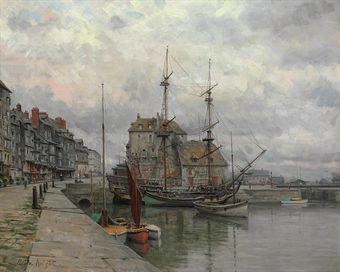
LOUIS ASTON KNIGHT - (1873 - 1948)


Aston Knight: Expressing the Poetry of Nature
Louis Aston Knight (son of the celebrated painter of French peasant life Daniel Ridgway Knight) was born in Paris on August 3, 1873. Aston Knight as he was known, followed in his father’s footsteps and painted in France and the United States until the middle of the twentieth century. 

spilling crimson says....By choice, Knight universally included bodies of water in his works. Bays, harbors, rivers and the world’s oceans all found their way onto his canvases.


Tuesday, May 24, 2011

MONOGRAMMA-ODYSSEAS ELYTIS~ Poveste de iubire(Historia De Un Amor)


spilling crimson says....The Monogram

by Odysseas Elytis

I will always mournhear me?for you, alone, in Paradise.

I

Fate, like a switchman, will turn
Elsewhere the lines of the palm
Time will concede for one moment

How else, since man loves and is loved

The heavens will perform our insides
And innocence will strike the world
With the scythe of deaths blackness.

II

I mourn the sun and I mourn the time that comes
Without us and I sing of others whove passed
If this is true

The bodies addressed and boats sweetly gliding by
The guitars that flicker under the waters
The believe me and the dont
One in the air and one in the music

The two small animals, our hands
That tried to climb one another in secret
The flowerpot cool through the open garden gate
And the parts of sea coming together
Beyond the dry-stone wall, beyond the hedge
The windflower you held in your hand
Whose purple shuddered three times for three days above the waterfall

If this is all true, I sing
The wooden beam and square tapestry
On the wall, the Mermaid with tresses unbraided
The cat that watched us in the dark


A child with incense and the red cross
The hour when night falls on unapproachable rocks
I mourn the garment that I fingered and the world came to me.
III

Like so I speak of you and me

Because I love you and in love I know
How to enter in like the full moon
From everywhere, about your small foot in the boundless sheets
How to pluck the jasmineand I have the power
To blow the wind and take you in sleep through the moons passages and the seas secret colonnade
Hypnotized tree of silvering spiders

The waves have heard of you
How you caress, how you kiss
Around the neck, around the bay
How you whisper the what and the eh
Always we the light and the shadow

Always you the little star and always I the dark vessel
Always you the harbor and always I the light shining from the right
The wet jetty and the glint on the oars
High on the vine-laden house
The bound roses and cooling water
Always you the stone statue and always I the shadow that grows
You the hanging shutter and I the wind that blows it open
Because I love you and I love you
Always you the coin and I the worship that gives it value

So much the night, so much the humming in the wind
So much the mist in the air, so much the stillness
Around the despotic sea
Heavenly arch full of stars
So much your faintest breath

That I no longer have anything else
Within these four walls, this ceiling and floor
But to call for you and for my own voice to hit me
To smell your scent and for people to fear
Because people cant bear the untried
And foreign and its early you hear
Its early still in the world my love

To speak of you and me.
IV

Its early still in this world, do you hear me
They havent tamed the beast, do you hear me
My wasted blood and sharp, hear me, knife
Like a ram running across the heavens
Breaking the tails of comets, hear me
I am, hear me
I love you, hear me
I hold you and I take you and I dress you
In the white gown of Ophelia, hear me
Where do you leave me, where do you go and who, hear me

Holds your hand above the flood
The enormous flames and volcanic lava
Will bury us, hear me, and the day will come
A thousand years later when we will be, hear me
Shining fossils, hear me
For the heartlessness of men to burnish, hear me
And throw above them in a thousand pieces
And on the waters one by one, hear me
I measure my bitter pebbles, hear me
And time is a great church, hear me
Where once the forms
Of saints
Shed true tears, hear me
The bells ring loudly, hear me
I cross a deep ford
Where the angels wait with candles and funeral psalms
I go nowhere, hear me
Neither or both together, hear me

This flower of the storm and, hear me
Of love
Once and for all, we pick it
And it never comes to flower anywhere else, hear me
On another earth, on another star, hear me
There isnt soil, there isnt air
That we touch, the same, hear me

And no gardener was ever so lucky


To produce such a flower from such a winter, hear me
And such northern winds, only we, hear me,
In the middle of the sea
Only from the mere wish for love, hear me
Raised an entire island, hear me
With caves and capes and crags in bloom
Listen, listen
Who speaks in the waters and who cries, hear
Who seeks the other, who calls, hear
I am the one who calls and I am the one who cries, you hear me
I love you and I love you, hear me.


Saturday, May 21, 2011

" DONNA CON TE " - ANNA OXA~ LOVE MEANS...


How many memories behind me
will mark them in the diary of life
and I will keep my old ones in this batticuori
white and red dress.
I'll be an angel for you
the woman who can make the heart
but if it occurs as the sun will kindle your senses
slowly and then extinguish them.
Woman with you who knows me know
woman with you if you want it.
Your hands on me
are already forcing my lock
but the door of my heart suddenly opens
and another woman will come out.
I'll be a woman who finds her femininity
and will give you the.
Woman makes you surprised only by its simplicity
and who will love you.
As the sky over us
my age if you can color it
and nights in black and white as the blot
Women's why I'll be with you.


spilling crimson says....